Colindale, NW9
Legionella Risk Assessments in Colindale
Water risk checks for Colindale flats and their warm risers.
- Free, no-obligation quotes
- Written assessment on the day
- Price confirmed before we attend
- Certificates and repairs on one account
- On the dayWritten assessment at the visit
- Price firstConfirmed before we attend
- NW9Colindale postcodes

In short
Do Colindale landlords need a legionella risk assessment?
Yes. Landlords must assess the risk from legionella to their tenants, but the law does not require a legionella certificate. In most new-build Colindale flats the risk is low. Warm risers, stored hot water and long empty spells between lets are what change it. We carry out the assessment and leave the written record on the day.
The assessment is a fixed price confirmed before we attend. It fits well into the same visit as an EICR or a check-in inspection.
The full guide is on our Legionella Risk Assessment page, and everything else we do locally is under landlord certificates and repairs in Colindale.
Legionella Risk Assessments in Colindale: what is different here
The cold supply in this zone arrives close to 20°C in summer
HSE's guidance asks for incoming and stored cold water below 20°C, and for cold outlets to fall below 20°C within two minutes of running. Affinity Water's 2025 report for the Colindale/Kingsbury zone, which supplied about 90,600 people, recorded water temperatures from 6.2°C to 23°C across 228 samples, with an average of 14.7°C. So in late summer the mains water can arrive with little margin before it even enters the building.
That makes how the cold pipes run inside a block more important here. On the visit we run the cold kitchen tap and record the temperature at two minutes. If it is still above 20°C, we note where the pipe runs and whether it shares space with heating pipes.
Heat networks and warm corridors
Colindale Gardens and the new Grahame Park phases are on heat networks, which means hot pipework running through the corridors, risers and ceiling voids of each block, all day and all year. Cold water pipes that share those spaces can pick up heat. Inside the flat, the cupboard holding the heat interface unit often has the cold main running past it.
The parts of this that sit in the common areas are the freeholder's. If a flat's cold water stays warm after running, our record says so, and you can pass it to the managing agent, whose own water safety arrangements cover the risers and any communal tanks or booster pumps.
How hot water reaches the flat changes the risk
HSE says the risk is lower where hot water is heated instantly rather than stored. Many heat interface units produce hot water on demand through a plate heat exchanger, much like a combi boiler, with little stored water in the flat. All-electric flats more often have an unvented electric cylinder, which HSE expects to store hot water at 60°C, with water reaching at least 50°C at the taps within a minute.
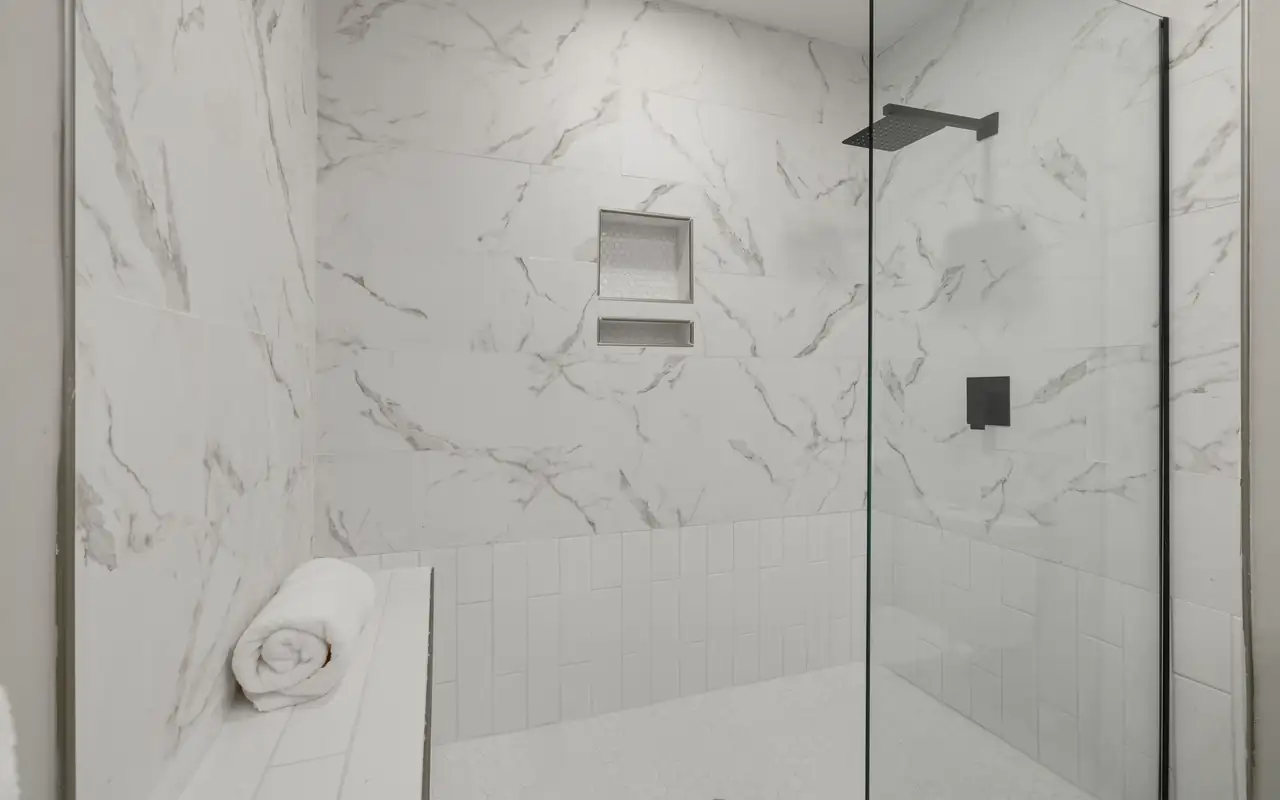
Older homes on and around Grahame Park may still have a cylinder and a cold water tank in the loft, and those tanks need a tight-fitting lid and should be free of debris. We record which type you have, the temperatures we measure, any redundant pipework or rarely used outlets, and the condition of shower heads.
Hard water and shower heads
The same zone report gives total hardness of 333 mg/l, with calcium at 133 mg/l. Scale builds up quickly inside shower heads, mixer cartridges and aerators, and scale gives bacteria somewhere to settle. HSE expects tenants to be told to clean shower heads regularly. In a Colindale flat with a rain shower or a concealed valve, we note the cleaning that is due and whether the head can be removed easily.
Empty flats between Colindale tenancies
With 43.5% of households in Colindale South, the ward that includes Beaufort Park, renting privately, flats change hands often, and a gap between tenancies is when water sits still. HSE's guidance is that outlets on hot and cold systems should be used at least once a week while a property is empty, and that the system should be flushed before a new tenant moves in.
For a longer void, a regular flushing routine or draining down may be needed. If your agent holds the keys between lets, agree who runs the taps and shower each week. We can flush the system and record the temperatures on the day of the assessment, which is useful just before a new tenancy.
No certificate, but keep the record
HSE states that health and safety law does not require landlords to obtain a legionella test certificate, and testing is usually unnecessary in a home. There is no fixed review interval either; the assessment should be looked at again when something changes, such as a new tenant, a long void or new plumbing. A written record is only a statutory requirement for employers with five or more employees.
Barnet's published HMO licence conditions do not set a separate legionella rule that we could find, but the HSE duty applies regardless, so a dated record on file is still the easiest evidence that you have assessed the risk.
Official sources
- HSE: legionella and landlords
- HSE legionella temperatures
- Affinity Water AF057 report, 2025
- Cambridge Network, September 2020: Colindale Gardens heat network
- Max Fordham on Grahame Park
- Census 2021 tenure, Colindale wards (Nomis)
Last reviewed October 2026 by EliteShires Property Services.
Price and booking
Certificates and defined jobs are a fixed price confirmed before we attend; repairs are charged by the hour, with the rate and an estimate confirmed before we attend. On our legionella risk assessments page: what a visit includes, step by step.
Every job is photographed before and after, and you get a time slot rather than a morning-or-afternoon window.
Related in Colindale: gas safety certificates, PAT testing, EPC and EICR.
Also nearby: legionella assessments in Edgware, and in Kenton and Stanmore.
Legionella Risk Assessments in Colindale: your questions
Not answered here? Call 0203 667 1333 and ask.
Does a Colindale flat with a heat interface unit need a legionella assessment?
Yes, every let needs the risk assessed. In a flat with instant hot water from a heat interface unit the risk is usually low, so the assessment is short, but the cold water temperature and any rarely used outlets still need checking.
Do I need a legionella certificate for my NW9 let?
No. HSE says landlords are not required to obtain a legionella test certificate. What you need is an assessment of the risk and sensible control measures.
My Colindale flat has been empty for a month. What should I do?
Flush every outlet, hot and cold, before the new tenant moves in. HSE expects outlets to be used at least weekly during a vacancy, so for future voids, agree who will run the taps.
The cold tap in my Colindale flat runs warm. Is that a problem?
It can be. HSE's target is below 20°C after two minutes of running. If yours stays warmer, the cold pipe may be picking up heat from heating pipes, and the managing agent should know if the cause is in the risers.
Who looks after the water tanks and pumps in my Colindale block?
The freeholder or managing agent. Communal tanks, booster pumps and risers sit outside your flat and are covered by the building's own water safety arrangements.
How often should a Colindale landlord review the assessment?
There is no fixed interval. Review it when something changes, such as a new tenancy, a long empty period or new plumbing.
Book legionella risk assessments in Colindale
Most quotes are settled on a two-minute call. Or send the form and we will call you back.
0203 667 1333 Or WhatsApp us on 07534 813123- We confirm the quote for your property
- We book a time slot that suits you or your tenant
- The water system is assessed and the written record issued
Visit the office
EliteShires Property Services
6 Station Parade, Kenton Lane
Harrow HA3 8SB
Call or WhatsApp
Opening hours
Mon – Fri · 8:00 – 18:00
Saturday · 9:00 – 16:30
Sunday · Emergencies only